4 December 2025,
Thursday


4 December 2025,
Thursday

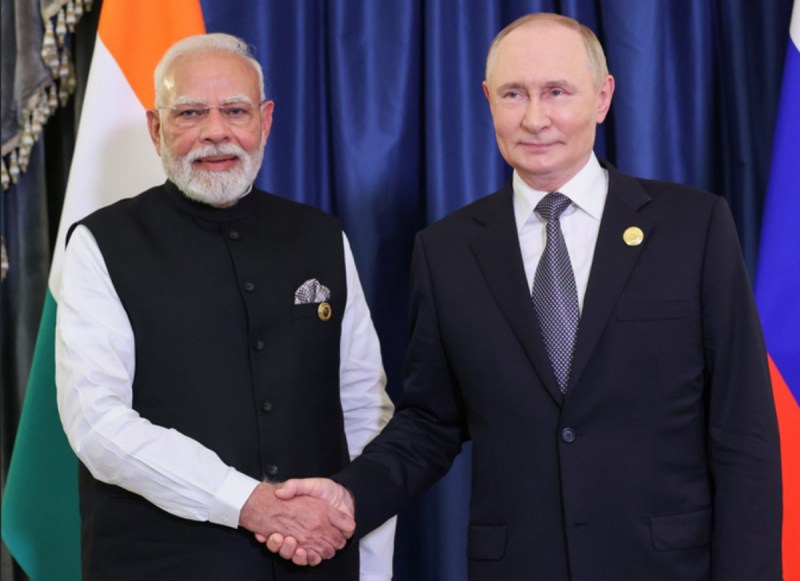
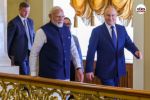
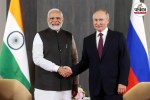
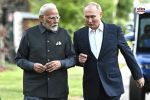
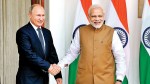
Indian Prime Minister Narendra Modi and Russian President Vladimir Putin (Photo - PM Modi's social media)
Russian President Vladimir Putin will be on a visit to India on December 4-5. Putin, who is coming to India at the invitation of Prime Minister Narendra Modi, will participate in the 23rd annual India-Russia summit. Kremlin spokesperson Dmitry Peskov informed about Putin's visit, stating that the S-400 air defence system will definitely be discussed during his visit to India. It is believed that India may purchase more S-400s. Peskov further said that the fifth-generation fighter jet Su-57 is also on the agenda for Putin's visit. Fifth-generation fighter jets are also a major requirement for the Indian Air Force.
India has been trying to build its own jet engine for a long time. Russia has also issued a statement on the joint production of jet engines. Regarding the joint production of jet engines, Peskov said that Russia is starting joint production ventures in India and this will continue. Whatever can be shared will be shared with India.
Russia's First Deputy Prime Minister Denis Manturov, speaking on the matter, said that joint development, co-production, and localisation have become the main pillars of India-Russia relations. According to Manturov, cooperation is now moving beyond simple supply contracts towards long-term technological partnerships. Manturov confirmed that the supply schedule for the S-400 is completely on track. The contract is being fulfilled within the timelines set by both parties.
The main dimension of Russia-India partnership is now moving towards technological cooperation, which also includes the 'Make in India' initiative. Military-technical cooperation between the two countries is of strategic importance, strengthening and developing every year.
Amidst the Russia-Ukraine war crisis, Putin's visit to India remains a topic of discussion in global diplomatic circles. The war, which has been ongoing for over 45 months, has polarised Europe. Meanwhile, India has called for 'peace talks' without succumbing to any pressure in over 50 G-20 meetings. India has also continued its Russian oil purchases. In 2024-25, India purchased oil worth over Rs 1.5 lakh crore from Russia. In this context, the Russia-Ukraine war will be a major issue in the Modi-Putin talks.
The purpose of the summit between India and Russia is not just defence or energy cooperation, but there are three fronts that are going to happen for the first time. This is what makes Putin's visit extraordinary.
Efforts are underway between the two countries to develop an alternative global payment system. This will be the first time that two major countries are exploring a parallel payment network outside the Western financial system. Under this, India's UPI and Russia's MIR card can together create a financial payment platform that will create a new alternative parallel to the Western SWIFT network. Western countries are particularly keeping an eye on this. According to experts, this could be the most revolutionary outcome of Putin's visit.
A new platform may open for Russia to officially recruit a large number of Indian workers from India. Russia is facing a severe shortage of labour and skilled professionals due to the war against Ukraine. It is estimated that Russia wants to recruit 1 million skilled and unskilled workers from India.
Open strategic dialogue with India is also important for Russia amidst the Russia-Ukraine war. Russia is looking towards its evergreen friend India to move away from over-reliance on China. From the perspective of diplomatic outcomes, it is clear that this is not just a bilateral development, it can change the global balance of power.
If one wants to understand the India-Russia relationship, there is perhaps no better symbol than the BrahMos missile. Two rivers, two streams of power, merging to form an unbreakable stream of life force. The word BrahMos is formed by combining two rivers from both countries: India's Brahmaputra and Russia's Moskva. History is a witness that BrahMos is not just a weapon, but a dynamic symbol of the shared capability of two civilisations, mutual trust, and decades of strategic friendship. The Brahmaputra symbolises India's cultural-military autonomy, and the Moskva symbolises Russia's strategic resolve and harsh geopolitical realities. The confluence of India's cultural confidence and Russia's technical-strategic heritage is reflected in the relations between the two countries. India-Russia relations have also been faster, more reliable, and more responsive than global diplomacy. This trust is rare in the world of diplomacy. While many strategic partnerships exist in the world, few reach the speed of trust at which the BrahMos flies. As the range of BrahMos increased, so did the relations between the two countries. Russian President Vladimir Putin's visit to India on December 4 is also going to be another major upgrade, an important milestone in the relationship between the two countries. It cannot be a mere coincidence that just before Putin's visit to India, on Monday, India conducted a combat launch of the BrahMos supersonic cruise missile in the Bay of Bengal. Launched by the Southern Command of the Indian Army, this missile flew at a speed of 3457.44 km/h and accurately hit a distant target. This launch was not just a test, but an announcement of a new phase of Russia-India friendship to the world. It should be noted that both countries have 'equal partnership contribution' in the design, development, and testing of BrahMos. This is a military cooperation that is almost unique in the world because it has neither dominance nor patronage. It only has partnership.
It is not that there have been no challenges in the friendship between India and Russia, but the stability and reliability of this relationship have strengthened it further while facing challenges. This aspect of friendship between the two countries can also be seen in the statement of Kremlin spokesperson Peskov before Putin's visit to India. Peskov said that India-Russia relations are not just a standard set of diplomatic protocols and trade agreements, but much more significant than that. The bilateral relations between the two countries are based on a deep historical background of mutual understanding, partnership, shared perspectives on global affairs, and the ability to consider international law, the rule of law, and each other's interests.
Peskov stated that Russia is proud to have stood shoulder to shoulder with its Indian friends during their historical development and is very grateful for India's current friendly stance and extremely friendly attitude towards Russia.
Big News
View AllWorld
Trending
Narendra Modi